

What if much of short-term momentum is just ETFs moving buckets on a calendar?
ETF rebalancing creates predictable, concentrated buy and sell waves that push individual stocks for days or weeks, independent of fundamentals.
That mechanical flow skews momentum rankings and creates timing luck: the same strategy can look very different if it rebalances in March versus June.
This piece explains the core mechanics, shows where distortions are largest (low float, high ETF ownership), and outlines simple ways traders can spot or avoid these calendar-driven opportunities.
Core Mechanisms Linking ETF Rebalancing to Stock-Level Momentum Shifts

ETF rebalancing creates concentrated, predictable order flow that mechanically shifts individual stock momentum by changing the balance between buyers and sellers during tight windows. When an ETF adjusts its holdings to track an index reconstitution, a sector reweighting, or a factor exposure refresh, it executes block trades that temporarily overwhelm natural supply and demand for the underlying stocks. You get a discrete price pressure event that either accelerates existing momentum (when buy flows hit winners) or triggers abrupt reversals (when sell flows hit laggards). Most momentum signals use 12-month lookback windows with a one-month lag, a construction adopted across NSE top-200 tests, U.S. large-cap models, and global factor portfolios. These rebalance-induced price moves inject artificial short-term returns that distort the very momentum signal ETFs try to capture.
The timing of these flows isn’t random. Fixed-calendar rebalances (monthly, quarterly, semi-annual) concentrate trades around index-provider cut-off dates and fund quarter-ends, creating predictable spikes in turnover and order-flow imbalances. A 24-year semi-annual global momentum test showed that rebalance timing alone produced an average 0.23 percent annual performance gap and up to 18 percent yearly divergence depending solely on whether the portfolio refreshed in March/September versus June/December. That’s the strategy construction held constant. Calendar-driven dispersion at that magnitude shows how sensitive momentum is to the exact timing of buy and sell waves. For individual stocks, the implication is direct: if a large ETF adds a name during a rebalance window, that stock gets a temporary demand boost that can push it higher on short-term momentum screens, even if the underlying fundamentals or longer-run price trend haven’t changed.
High-frequency rebalancing amplifies these dynamics. Monthly momentum rebalances in U.S. backtests delivered 2 to 3x the returns of quarterly schedules across multiple long-term models, largely because monthly refreshes captured fresher signals and exited fading winners sooner. ETFs that rebalance monthly face correspondingly higher turnover and liquidity demands, which increases market impact and short-term price disturbances. The core channels through which ETF rebalancing mechanically alters stock momentum include:
Block-trade order flow concentration: ETF basket creation and redemption orders arrive in large, discrete blocks that temporarily tilt stock price in the direction of the trade, injecting momentum that may reverse once the flow subsides.
Intraday liquidity depletion: rebalancing trades consume available bids or offers, widening spreads and amplifying price moves for the same volume. Particularly in mid and small-cap names with thinner order books.
Calendar clustering: when multiple ETFs rebalance on the same dates (end-of-month, end-of-quarter), aggregate buy or sell pressure spikes, creating correlated momentum shifts across a basket of stocks that share index membership.
Signal contamination: because momentum rankings use recent returns, the temporary price jump or drop from rebalance flow can elevate or demote a stock in subsequent momentum sorts, feeding forward into the next cycle.
Turnover-driven volatility: higher rebalance frequency raises turnover, which shortens the holding period for momentum positions and increases the chance that short-term price noise (including ETF flow noise) gets mistaken for persistent trend.
Asymmetric impact by liquidity: stocks with low float or high ETF ownership experience larger percentage moves per dollar of flow, making them more vulnerable to momentum distortions and creating exploitable short-term patterns around known rebalance windows.
ETF Rebalance Calendars and Predictable Momentum Distortions

ETF rebalance schedules mirror the discrete-frequency decision points used in systematic momentum strategies, and they introduce the same timing-luck variability into individual stock returns. A momentum portfolio that rebalances monthly versus quarterly is making fundamentally different bets on how quickly momentum signals decay and how often stale exposures should be culled. Optimal rebalancing frequency research on momentum portfolios has shown that monthly refreshes dramatically outperformed quarterly and annual schedules, often by a factor of two or three over multi-decade backtests, because momentum is short-lived and driven by episodic news, earnings surprises, and sentiment shifts that fade within weeks. ETFs targeting momentum, sector leadership, or thematic exposures face the same decay dynamics: delay the rebalance, and the portfolio drifts into yesterday’s winners while missing today’s movers. The fixed calendar imposed by most index providers creates a rhythm of predictable flow that individual stocks learn to anticipate, and that predictability itself becomes a source of momentum distortion.
The persistence of these calendar effects isn’t trivial. In the 24-year semi-annual global momentum backtest that compared March/September rebalances against June/December rebalances, performance gaps weren’t white noise that averaged out over time. They persisted for multiple years. From 2007 to 2015, the March/September variant materially outperformed both the June/December variant and the market-cap benchmark, then the relationship reversed from 2015 to 2024. These multi-year divergences show that rebalance timing interacts with regime shifts, liquidity cycles, and aggregate flow patterns in non-mean-reverting ways. For stocks with high ETF ownership, a single rebalance-date decision by a large fund can lock in years of recurring buy or sell pressure at fixed intervals, creating a calendar-linked momentum signature that has nothing to do with the stock’s intrinsic return drivers.
| Rebalance Window | Expected Stock-Level Momentum Distortion |
|---|---|
| Monthly | High turnover and frequent flow pulses; short-term momentum spikes and rapid reversals; elevated intraday volatility around month-end; greater sensitivity to recent news and earnings. |
| Quarterly | Concentrated end-of-quarter flows; larger block trades and deeper temporary price impact; multi-week momentum drift as trades are anticipated and executed; higher calendar clustering with institutional window dressing. |
| Semi-Annual | Extreme flow concentration twice per year; large basket trades that can move entire sectors; long periods of stale exposures between rebalances; timing luck drives multi-year performance gaps; individual stocks experience sharp, infrequent adjustments with slow mean reversion. |
Why Timing Luck Matters for ETF Flows
Timing luck is the performance variability that arises purely from the calendar timing of portfolio refreshes, not from signal construction or stock selection. When two identical momentum strategies produce materially different multi-year returns solely because one rebalances in March and the other in June, the implication is that discrete, lumpy market moves (earnings announcements, Fed decisions, geopolitical shocks) fall unevenly across rebalance windows. The exact date determines which moves are captured or missed. For ETFs, timing luck becomes an uncompensated, non-diversifiable risk embedded in the rebalance calendar. A fund that rebalances on the last trading day of each quarter will systematically include or exclude certain return episodes relative to a fund that rebalances mid-quarter, and those differences compound over time.
This matters because investors and traders often compare ETF returns without accounting for calendar differences, mistaking timing luck for alpha or skill. It also matters for the underlying stocks: predictable rebalance dates create predictable flow patterns, and those patterns can be front-run or exploited by informed traders who know when large baskets will hit the market. The resulting price pressure isn’t compensation for risk. It’s mechanical, temporary, and driven purely by the logistics of index tracking. Stocks that happen to be added during a period of broad market strength will receive a momentum tailwind that amplifies their short-term return and elevates their rank in subsequent momentum sorts, even if the fundamental or technical case hasn’t improved. Conversely, stocks deleted during stress periods face compounded selling pressure that can trigger stop-losses, margin calls, and additional forced selling, creating a downward momentum spiral that reverses only after the rebalance flow has cleared.
Liquidity, Order Flow, and Market Microstructure During ETF Rebalancing

ETF rebalancing triggers temporary liquidity shocks that alter the microstructure environment for individual stocks, widening spreads, depleting order-book depth, and increasing the price impact per share traded. When an ETF executes a large basket trade to adjust factor exposures or track an index reconstitution, it competes with regular market flow for the same limited liquidity. Particularly in mid and small-cap names. Liquidity screens (filtering for mid and large-cap stocks with sufficient trading volume) are standard practice in high-frequency momentum systems precisely because frequent rebalancing in illiquid names can generate market impact that erodes net returns. The same constraint applies to ETFs: rebalance a thinly traded stock, and the act of trading moves the price against you, creating slippage that shows up as tracking error or reduced performance relative to the index.
Order-flow imbalances during rebalance windows aren’t subtle. On rebalance days, the ratio of buy orders to sell orders can spike or collapse depending on which stocks are being added or removed, and that imbalance temporarily overwhelms the market’s ability to absorb the flow at stable prices. Bid-ask spreads widen as market makers adjust their quotes to reflect inventory risk and information asymmetry. Rebalance flow is predictable but the timing and size can vary, so dealers demand a premium to provide liquidity. Dark pools and algorithmic execution strategies help institutions reduce visible market impact, but they can’t eliminate it entirely, especially when multiple ETFs rebalance on the same day and compete for the same hidden liquidity. The result is a cascade of microstructure stress that feeds back into short-term momentum: stocks receiving heavy buy flow show temporary upward momentum that may reverse once the rebalance is complete, and stocks hit with concentrated selling show temporary downward momentum that may mean-revert when selling subsides.
The channels through which rebalance-induced microstructure stress distorts individual stock momentum include:
Order book depletion: large rebalance trades consume the top layers of the limit order book, forcing subsequent orders to walk the book and accept worse prices, which amplifies short-term price moves and creates temporary momentum.
Spread widening: dealers widen bid-ask spreads in anticipation of rebalance flow, raising transaction costs for all participants and reducing the effective liquidity available to absorb the trades, which magnifies price impact.
Information leakage and front-running: predictable rebalance calendars allow informed traders to position ahead of the flow, buying stocks likely to be added and shorting stocks likely to be removed, which creates pre-rebalance momentum that reverses post-rebalance.
Cross-asset correlation spikes: rebalance flow can temporarily increase the correlation of stocks within the same ETF basket, as the mechanical buy or sell pressure swamps idiosyncratic fundamentals and creates a common factor driven purely by index membership.
Small-cap vulnerability: stocks with low market capitalization and thin float experience disproportionately large percentage moves per dollar of rebalance flow, making them hotspots for temporary momentum distortions and exploitable short-term patterns around rebalance dates.
Case Studies: Stocks With High ETF Ownership and Momentum Distortions
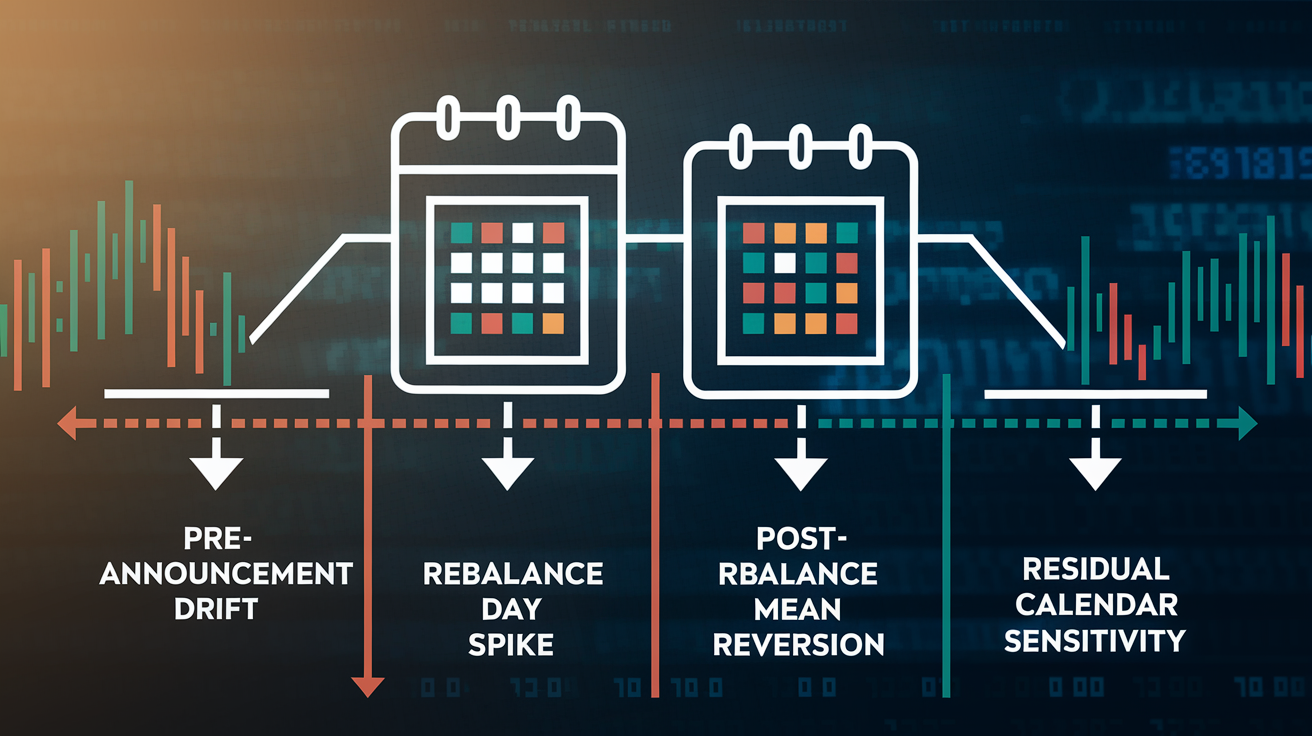
Stocks with high ETF ownership are particularly vulnerable to calendar-driven momentum distortions because a large fraction of their trading volume arrives in predictable, concentrated waves tied to index rebalances rather than organic fundamental or technical signals. When multiple ETFs hold the same stock and rebalance on overlapping schedules, the aggregate flow can dwarf average daily volume, creating price moves that temporarily dominate the stock’s momentum profile. Thematic and sector ETFs amplify this dynamic by concentrating flows into narrower baskets: a clean-energy ETF rebalance might trade dozens of small-cap renewable names in a single day, injecting momentum that fades once the basket trade is complete. Strategies that target top-decile or top 5 percent momentum names (such as the Twin Momentum model that selects the top 5 percent meeting both fundamental and price hurdles) create heavy concentration in a small number of winners. When those same names appear in thematic ETF baskets, the overlap produces correlated, calendar-linked flow that can drive short-lived momentum bursts or abrupt unwinds.
The typical pattern observed in high-ETF-weight names includes four phases:
Pre-announcement drift: as index reconstitution or factor rebalance dates approach, informed traders and algorithms anticipate likely adds and deletes, creating gradual upward drift in prospective additions and downward drift in prospective deletions. This is momentum that precedes the actual rebalance flow.
Rebalance-day spike or drop: on the actual rebalance date, concentrated basket trades create sharp intraday price moves, often with elevated volume and widened spreads. This is the peak of the temporary momentum distortion.
Post-rebalance mean reversion: in the days and weeks following the rebalance, prices partially reverse as the temporary order-flow imbalance dissipates and natural supply-demand dynamics reassert. This is when short-term momentum traders unwind and the artificial component of the move fades.
Residual calendar sensitivity: even after mean reversion, the stock retains elevated sensitivity to the next rebalance window, creating a recurring calendar pattern that can be detected in event studies and exploited by traders who position ahead of known dates.
Sector and Thematic ETFs as Momentum Amplifiers
Sector and thematic ETFs create particularly pronounced momentum distortions because they concentrate capital into narrow slices of the market with shared characteristics. Their rebalances often coincide with industry rotation or narrative shifts that are themselves momentum drivers. When a sector ETF rebalances to increase exposure to the top performers within that sector, it’s mechanically buying recent winners and selling recent losers. The same logic as a momentum strategy. But the flow is large, predictable, and unrelated to individual stock fundamentals. If the sector is experiencing a momentum surge driven by macro news or earnings beats, the ETF rebalance amplifies that surge by adding concentrated demand for the same names that are already attracting discretionary capital. The result is a feedback loop: strong recent returns trigger ETF inflows, which trigger rebalancing buys, which push prices higher, which attract more inflows, creating a short-term momentum spiral that can reverse sharply once the narrative shifts or the rebalance flow ends.
Thematic ETFs (focused on trends like artificial intelligence, cloud computing, or electric vehicles) take this dynamic further by targeting small, illiquid names with limited float and high growth expectations. A single thematic ETF rebalance can represent a significant fraction of a stock’s average daily volume. When multiple thematic funds hold overlapping portfolios and rebalance on similar schedules, the aggregate flow can create multi-day price runs that appear as momentum signals but are actually mechanical artifacts of basket trading. These runs often reverse quickly, leaving behind elevated volatility and tracking error, but the temporary momentum can be strong enough to trigger additional buying from trend-following algorithms and momentum-based hedge funds, compounding the distortion until the flow subsides.
Quantitative Tools for Measuring ETF-Driven Momentum Effects

Measuring the causal impact of ETF rebalancing on individual stock momentum requires isolating the mechanical flow effect from other contemporaneous drivers such as earnings, news, and broader market moves. The standard approach is an event-study methodology that compares stock returns and trading activity in narrow windows around known rebalance dates, using a control group of similar stocks that aren’t subject to the same rebalance flow. Event studies were used extensively in the scraped research to isolate timing effects: weekly versus monthly versus quarterly rebalances were compared in NSE top-200 momentum tests, and semi-annual rebalances (March/September versus June/December) were compared in a 24-year global backtest, with performance gaps up to 18 percent in some years. These frameworks demonstrate how to attribute return differences to timing rather than signal construction, and the same logic applies to ETF-driven momentum distortions. Compare stocks added or removed during a rebalance window to matched stocks that weren’t, and measure the incremental return, volume, and volatility in the days surrounding the event.
The key metrics tracked in these event studies include cumulative abnormal return (the stock’s return minus the expected return from a factor model or matched peer group), abnormal trading volume (actual volume minus historical average, often expressed as a multiple), and order-flow imbalance (buy volume minus sell volume, normalized by total volume). By plotting these metrics from several days before the rebalance through several days after, researchers can identify the typical pre-announcement drift, rebalance-day spike, and post-rebalance mean reversion pattern. Cross-sectional regressions further isolate which stock characteristics (market cap, ETF ownership percentage, liquidity, volatility) amplify or dampen the rebalance effect, providing a template for predicting which names are most vulnerable to calendar-driven momentum distortions.
Data requirements for this analysis include precise rebalance dates and constituent lists from index providers, intraday trading and order-book data to measure microstructure changes, and ETF holdings data to quantify ownership concentration. Alternative data sources such as dark pool prints, options flow, and short interest can provide additional context on how traders position around rebalance events.
| Event Window | Key Metrics | Data Needed |
|---|---|---|
| Pre-rebalance (T-5 to T-1) | Cumulative abnormal return, abnormal volume, order-flow imbalance, bid-ask spread changes | Daily and intraday price/volume, historical factor loadings, peer group definitions, dark pool and institutional flow data |
| Rebalance day (T=0) | Intraday high-low range, volume spike magnitude, spread widening, market impact per share, realized slippage | Tick-by-tick trade and quote data, order book snapshots, execution timestamps, ETF creation/redemption activity |
| Post-rebalance (T+1 to T+20) | Mean reversion speed, volatility decay, residual abnormal return, correlation with next rebalance window | Daily returns and volume, ETF holdings changes, short interest updates, options implied volatility, subsequent index constituent lists |
How ETF Rebalancing Interacts With Momentum Strategies Used by Traders

Active momentum traders and hedge funds often structure their strategies to exploit the predictable flow patterns created by ETF rebalances, positioning ahead of known index additions or deletions and unwinding once the mechanical flow has passed. The logic is straightforward: if a stock is likely to be added to a major momentum ETF at month-end, buying it a few days early allows the trader to capture the temporary demand surge when the ETF executes its basket, then selling into that surge locks in a return driven purely by order flow rather than fundamentals. The profitability of this approach depends on how predictable the rebalance is, how large the flow will be relative to normal liquidity, and how quickly other traders front-run the same opportunity and erode the edge. Because many momentum signals use 12-month lookback windows with a one-month lag (a construction validated across NSE, U.S., and global backtests), traders can reverse-engineer likely additions and deletions by ranking stocks on the same signal the ETF uses, then positioning accordingly.
The interaction cuts both ways. ETF rebalancing can distort the momentum signals that active traders rely on, injecting artificial short-term returns that elevate or demote stocks in subsequent momentum sorts. Monthly rebalancing is key to capturing fleeting momentum signals before they decay, and the large return gaps observed in long-term U.S. momentum models (monthly rebalancing delivered +1,220.7 percent versus quarterly +442.5 percent in one 2003 to 2024 backtest) show how sensitive momentum is to timing. When an ETF rebalances monthly, it competes directly with active momentum strategies for the same short-term price moves, and the resulting flow can create feedback loops that amplify or dampen the underlying trend. Active traders must account for ETF rebalance schedules as a source of both opportunity and noise: the temporary boost from a rebalance can offer a quick scalp, but it can also create false signals that reverse sharply once the flow subsides.
The most common ways traders position around ETF rebalance flows include:
Pre-rebalance accumulation: buying stocks likely to be added (or shorting stocks likely to be removed) in the days leading up to the rebalance, capturing the drift as other traders and algorithms anticipate the same flow.
Rebalance-day execution: using limit orders or algorithmic strategies to provide liquidity to the ETF’s basket trade, earning the bid-ask spread or market-impact premium in exchange for taking the other side of the flow.
Post-rebalance fade trades: shorting recent additions or buying recent deletions immediately after the rebalance, betting on mean reversion once the temporary order-flow imbalance dissipates.
Calendar-based momentum overlays: incorporating known rebalance dates into momentum signals, either by adjusting lookback windows to exclude rebalance-driven spikes or by tilting toward stocks with favorable rebalance timing relative to their momentum rank.
Volatility arbitrage: selling options on high-ETF-ownership stocks ahead of rebalances, capturing elevated implied volatility that often exceeds realized volatility once the event passes and flow normalizes.
Anticipatory Trading and Front-Running Dynamics
Anticipatory trading around ETF rebalances creates a game-theory dynamic where the value of positioning early depends on how many other traders are doing the same thing. In the early years of index investing, rebalance flow was less anticipated and front-running opportunities were more profitable, but as ETF assets under management grew and index methodologies became transparent, the edge from simple pre-announcement buying eroded. Today, sophisticated algorithms and hedge funds monitor index constituent rankings in real time, and they begin positioning as soon as a stock crosses the threshold that makes addition or deletion likely. This creates a cascade: early front-runners push the stock’s price in the direction of the anticipated flow, which attracts more traders, which amplifies the move, which can itself trigger technical signals that attract momentum-following systems unaware of the underlying rebalance catalyst.
Much of the rebalance-driven price move now occurs before the official rebalance date, compressed into the announcement window or the final days of the ranking period. By the time the ETF executes its basket trade, the stock may have already moved significantly, leaving less room for additional momentum and a higher risk of sharp reversal once the flow clears. This front-running dynamic is most pronounced in small-cap and thematic names, where the ratio of anticipated flow to average daily volume is highest and the information advantage of knowing the rebalance schedule is most valuable. For active momentum traders, the implication is clear: the first-order opportunity from ETF rebalances has been largely arbitraged away, but the second-order effects (volatility spikes, temporary liquidity shocks, and post-rebalance mean reversion) remain exploitable for traders who can execute quickly and manage risk tightly.
Risk Management and Execution Approaches Around ETF Rebalance Windows
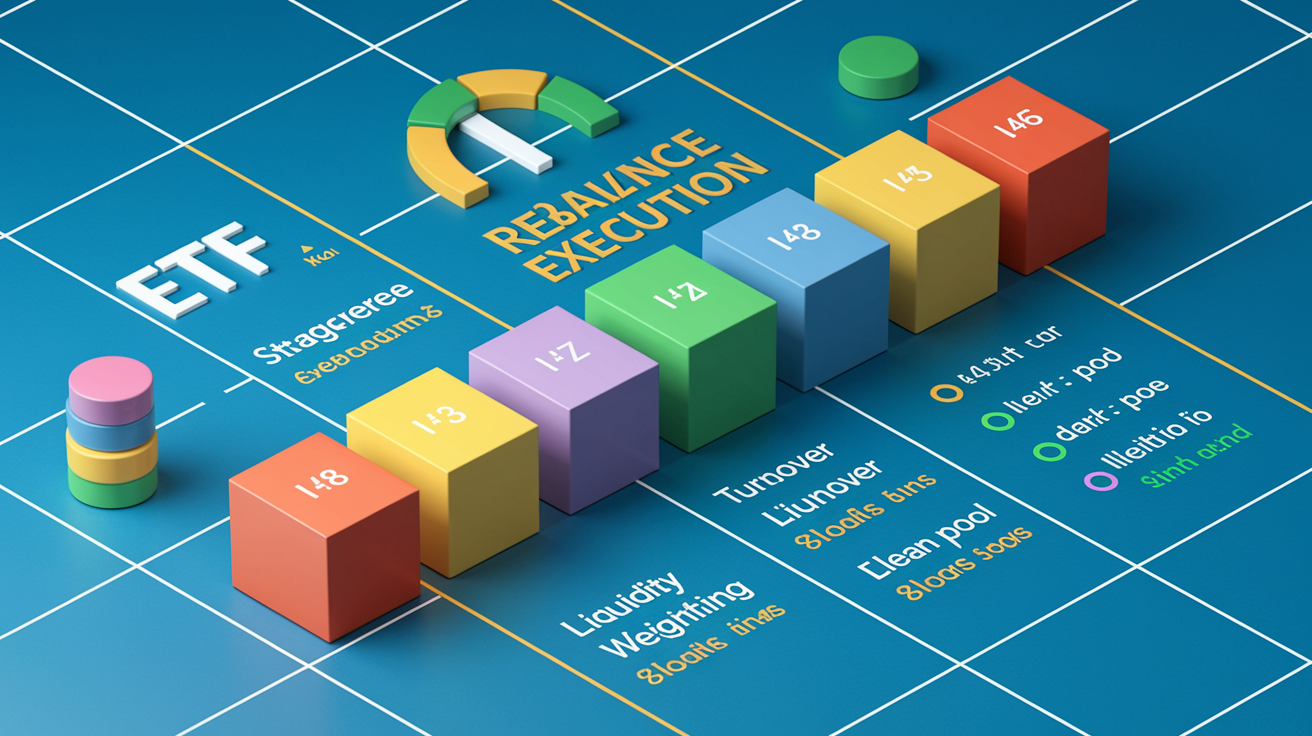
Institutional traders executing large orders around ETF rebalance windows face heightened slippage, market impact, and execution risk due to the temporary liquidity shocks and order-flow imbalances that concentrate during these periods. The practical solutions developed in momentum portfolio research (staggered rebalancing, turnover caps, and frequency adjustments) translate directly to ETF rebalance execution. Staggered rebalancing splits the basket trade across multiple days or even weeks, reducing the peak order size and spreading the market impact over a longer window, which helps avoid the worst of the rebalance-day liquidity squeeze. A turnover cap (such as the 30 percent per-rebalance limit suggested in the scraped studies) prevents the portfolio from churning excessively and limits the total flow that must be absorbed by the market in a single event, reducing the chance of extreme price moves and tracking error.
Liquidity mismatch risk is a central concern for ETF managers, particularly when the ETF trades continuously on an exchange but the underlying stocks trade in less liquid markets or during different time zones. When an ETF rebalances, it must execute trades in the underlying stocks, and if those stocks have limited liquidity, the ETF may face significant slippage and tracking error. Authorized participants (APs) help mitigate this through the creation and redemption mechanism, which allows the ETF to exchange baskets of underlying stocks for ETF shares without hitting the secondary market, but this mechanism is most effective for large, liquid stocks and less effective for small-cap or international names. Basket trade timing is critical: executing during periods of peak liquidity (market opens, closes, or after major economic releases) reduces market impact, while avoiding periods of thin liquidity (holidays, low-volume days) reduces the risk of extreme price moves.
Practical risk-mitigation tactics for institutional traders and ETF managers include:
Staggered execution: split rebalance trades across multiple days or intraday windows to reduce peak order size and spread market impact, avoiding the concentration of flow that creates temporary liquidity shocks and sharp price moves.
Turnover constraints: impose per-rebalance turnover caps (example: 30 percent) to limit the total flow and reduce the frequency of full portfolio refreshes, balancing the need for fresh exposures against transaction costs and execution risk.
Liquidity-weighted execution: allocate more trading volume to highly liquid stocks and use smaller order sizes or longer execution windows for illiquid names, reducing market impact and slippage in the most vulnerable positions.
Dark pool and algorithmic routing: use dark pools, conditional limit orders, and smart-order routers to access hidden liquidity and minimize information leakage, reducing the risk of front-running and adverse selection during rebalance windows.
Calendar diversification: vary rebalance dates across different funds or portfolios to avoid clustering all flow on the same day, reducing the aggregate market impact and lowering the risk of correlated momentum distortions across the portfolio.
Designing Research and Monitoring Frameworks for ETF Rebalance Momentum Effects

Systematic tracking of ETF rebalance cycles requires a monitoring framework that integrates index-provider calendars, ETF holdings data, and real-time flow indicators to detect when and where rebalance-driven momentum distortions are likely to occur. The first step is compiling a calendar of known rebalance dates from major index providers (MSCI, S&P, FTSE Russell, and others) along with the constituent lists and weighting methodologies that determine which stocks will be added, removed, or reweighted. Because identical momentum strategies with different rebalance dates produced materially different multi-year performance in the 24-year global backtest, it’s essential to track multiple timing configurations and compare performance across them to isolate timing luck from alpha. This requires running parallel simulations or shadow portfolios that mirror the ETF’s strategy but rebalance on staggered dates, then measuring the dispersion in returns to quantify the magnitude of calendar-driven effects.
Alternative data sources provide early warning signals of impending rebalance flow. ETF creation and redemption activity (published daily by ETF issuers) reveals when large inflows or outflows are occurring, which often precede rebalance trades. Options flow and put-call ratios can signal how traders are positioning ahead of known rebalance dates, and spikes in implied volatility often indicate anticipated near-term price moves tied to index events. Short interest data helps identify stocks under pressure from anticipated deletions or stocks being accumulated ahead of anticipated additions. By combining these signals with historical event-study results, traders and allocators can build predictive models that estimate the likely price impact, volume spike, and mean-reversion path for individual stocks during upcoming rebalance windows.
The essential components of a rebalance-monitoring framework include:
Index-provider calendar integration: maintain a database of rebalance dates, methodology changes, and constituent-list updates from all major index providers, flagging which stocks are likely to be added or removed based on current rankings.
ETF holdings and flow tracking: monitor daily creation/redemption activity and periodic holdings disclosures to identify which ETFs have concentrated exposure to specific stocks and when large basket trades are likely to occur.
Event-study templates: maintain a library of historical rebalance events with measured price impact, volume spike, and mean-reversion parameters, segmented by stock characteristics (market cap, liquidity, ETF ownership) to provide benchmarks for expected distortions.
Real-time flow indicators: integrate intraday volume, order-flow imbalance, dark pool prints, and options flow to detect when rebalance-related trading is occurring, allowing for dynamic adjustment of execution strategies or tactical positioning.
Using Cross-Asset and Flow Data to Detect Distortions
Cross-asset signals (such as bond yields, currency moves, and volatility indices) provide macro context that can amplify or dampen ETF-driven momentum distortions at the individual-stock level. When broader risk appetite is strong and flows into equity ETFs are positive, rebalance-driven buying pressure is more likely to create persistent upward momentum because it aligns with the underlying trend. Conversely, when risk sentiment is weak and ETF redemptions are elevated, rebalance-driven selling pressure can trigger cascading declines and margin calls, creating downward momentum spirals that extend well beyond the mechanical flow itself. Flow data from related asset classes (such as sector rotation within equity markets, flows into leveraged or inverse ETFs, and international capital flows) helps triangulate whether a stock’s momentum is driven by fundamental or technical factors versus purely mechanical rebalancing, allowing traders to adjust position sizing and risk management accordingly.
Final Words
In the action, ETF rebalances mechanically drive short bursts of buy and sell pressure that nudge stock-level momentum — fixed calendars, block trades, and order-flow imbalances often create predictable intraday moves.
We covered how rebalance frequency and timing change returns, why liquidity and microstructure amplify effects for smaller names, and which empirical tools help separate flow-driven moves from true momentum.
Watch rebalance calendars, order-book depth, and high-ETF-weight names; they’re the highest-probability triggers.
Understanding the impact of ETF rebalancing on individual stock momentum gives you a clearer lens on short-term distortions — with good monitoring, those distortions become manageable opportunities.
FAQ
Q: What happens when an ETF rebalances?
A: When an ETF rebalances, the fund buys or sells basket constituents to match new index weights, creating short-term buy/sell pressure, wider spreads, and temporary price moves or slippage in affected stocks.
Q: What is the 7% rule in ETF?
A: The 7% rule in ETFs refers to no formal regulation; it’s a practitioner heuristic some use as a cutoff for rebalancing, turnover caps, or concentration limits—definitions and use vary by issuer.
Q: What is Warren Buffett’s 70/30 rule?
A: Warren Buffett’s 70/30 rule describes a simple guideline of roughly 70% stocks and 30% bonds for many investors, emphasizing low-cost index funds, long-term holding, and minimal trading.
Q: Did Warren Buffett dump his ETFs?
A: Warren Buffett did not dump his ETFs; he has publicly recommended broad-market index funds and there’s no public record of him selling a large, concentrated position in mainstream ETFs en masse.