

Can one regulator’s decision really swing Bitcoin 20% in days?
Yes, and here’s why.
Regulatory moves change sentiment, restrict who can buy or sell, and reshape market plumbing.
That means liquidity (how easily you can buy or sell) tightens, volatility spikes, and long-term demand shifts when institutions get a green light or are blocked.
This post maps the mechanics: enforcement actions, custody rules, taxes, and ETF approvals, and what each does to price.
Watch for clear rules, big enforcement moves, and banking or custody access changes.
How Regulations Mechanically Influence Bitcoin’s Price

When a regulator drops an enforcement action or passes new legislation, Bitcoin’s price usually reacts fast. Sometimes within hours. The first thing moving is sentiment. Traders reprice risk based on what they see in the headlines, often before they’ve even read past the first paragraph. A ban gets announced and fear kicks in. An ETF gets approved and optimism floods back. Both scenarios create sharp volatility spikes as people either front-run what they think is coming or bail out to cut their exposure. These quick moves show how the market collectively interprets whether regulation is about to change Bitcoin’s legal standing, how accessible it’ll be, or what future demand looks like.
The speed of repricing also tells you something about enforcement risk. When the SEC went after Ripple on December 22, 2020, XRP tanked over 40% in a matter of days. Exchanges delisted it. Institutional buyers froze. Bitcoin dropped in sympathy, shedding somewhere around 10 to 15% as traders started pricing in the idea that broader regulatory scrutiny was coming for the whole sector. How hard and how fast these reactions hit depends on how clear the announcement is, how much weight that jurisdiction carries in global markets, and what positions people already have open. Leveraged traders and thin order books just make everything bigger.
Short-term reactions you’ll typically see:
- Sharp intraday volatility as algos and retail both pile in.
- Volume spikes and wider spreads when liquidity providers back off.
- Correlation across the crypto space. Bad news for one token usually drags Bitcoin down too.
- Cascading liquidations in derivatives when price drops trigger margin calls.
- Rapid shifts in on-chain activity as people move coins to or from exchanges, trying to get ahead of restrictions.
But behind all that immediate chaos sit deeper forces that actually drive sustained price changes over weeks or months. Regulation doesn’t just mess with sentiment. It reshapes the structure of the market by changing who’s allowed in, how much capital can flow, and what’s legally viable to do with Bitcoin.
Liquidity and Market Access Restrictions
When regulators ban exchanges or cut off banking access, Bitcoin’s liquidity just disappears in that region. China’s September 2021 ban on crypto transactions didn’t only signal disapproval. It physically removed Chinese trading volume from the global picture. Exchanges serving mainland users either shut down or moved. The channels people used to get money in and out closed. What happened immediately was a liquidity squeeze: fewer buyers at any price, spreads widening, volatility going crazy. Bitcoin fell about 15% in the days after that announcement, then stayed under pressure as miners and institutions scrambled to reposition.
Banking barriers hit just as hard. When regulators lean on banks to refuse accounts for crypto exchanges, those platforms lose their fiat rails. Deposits slow down. Withdrawals take forever. Traders face friction getting capital in or out, which shrinks the pool of active participants and makes selling pressure hit harder. India’s informal guidance in 2018 didn’t officially ban Bitcoin, but it discouraged banks from serving crypto businesses. Result? Retail access tanked and local trading volume got crushed for years.
Fragmentation is a problem too. When big markets impose restrictions, global liquidity doesn’t just smoothly move somewhere else. Trading gets concentrated in whatever jurisdictions are left, often offshore or in places where compliance is looser and counterparty risk is higher. That concentration increases systemic fragility. A single exchange blowing up in a fragmented market can cause sharper dislocations than the same failure would in a liquid, diversified one.
Institutional Adoption and Custody Frameworks
Regulatory clarity unlocks institutional money by resolving legal uncertainty around custody, fiduciary duty, and what Bitcoin even counts as. Before January 10, 2024, U.S. institutions faced real barriers to Bitcoin exposure: no spot product approved by the SEC, unclear custody standards, compliance risk if they held it directly. When the SEC approved the first U.S. spot Bitcoin ETFs, those barriers came down. Within weeks, billions poured into the new products. Bitcoin’s price went up roughly 50% in the months after as institutional demand that had been sitting on the sidelines finally showed up through compliant, liquid vehicles.
Custody rules are the practical chokepoint. Institutional money managers have fiduciary standards that require qualified custodians. When regulators confirm that banks or specialized firms can legally hold Bitcoin for clients, those managers can finally allocate. The CFTC’s 2017 self-certification for bitcoin futures was an earlier version of this: it let CME and CBOE list contracts, giving institutions their first regulated way in. Open interest grew, and spot prices responded to that new layer of demand from hedge funds and asset managers using derivatives.
ETF approvals also deepen liquidity and tighten spreads by bringing in market makers and authorized participants who arbitrage the ETF price against spot Bitcoin. That tighter connection between product and asset reduces short-term volatility and makes Bitcoin more appealing to risk-averse allocators who need liquid, transparent markets.
Legal Classification and Market Use-Cases
The distinction between commodity, security, and currency determines who regulates Bitcoin, what disclosures you need, and which institutions can legally touch it. When the CFTC said Bitcoin was a commodity (affirmed in cases like CFTC v. McDonnell in 2018), it clarified that Bitcoin could trade on CFTC-regulated derivatives exchanges and that spot Bitcoin fell outside securities law for commodity enforcement purposes. That clarity let futures, options, and eventually ETFs launch under a known framework.
When classification stays ambiguous, institutional participation gets suppressed. If Bitcoin’s legal status is unclear, compliance departments just block allocation. Exchanges don’t want to list products. Banks avoid custody. The SEC’s enforcement-first approach (filing lawsuits without issuing clear rules) created years of uncertainty. Institutions either sat out or moved offshore. Price suffered because the pool of potential buyers stayed small.
When courts or regulators draw bright lines, the market reprices right away. Judge Torres’s July 2023 ruling in SEC v. Ripple held that secondary-market XRP sales weren’t securities transactions. It didn’t directly involve Bitcoin, but it signaled a legal path for other tokens and backed the idea that decentralized assets could trade outside securities law. Bitcoin rallied a bit as traders read the ruling as lowering systemic regulatory risk across crypto.
Taxation, Reporting, and Forced Selling
Tax rules change how people hold and when they sell. The IRS’s 2014 guidance that crypto is property (not currency) meant every Bitcoin transaction triggers capital gains reporting. That administrative hassle discourages small transactions and pushes people toward long-term holds. It also creates predictable year-end and quarterly tax-loss harvesting, when investors dump losing positions to offset gains. Those concentrated selling windows add downward pressure to seasonal price patterns.
India’s 2022 budget brought a 30% tax on crypto gains plus a 1% tax deducted at source on every transaction. The TDS mechanism (where exchanges withhold 1% of transaction value and send it to the government) effectively raised the cost of trading. Retail volume in India collapsed. Trading moved offshore or peer-to-peer. Bitcoin’s liquidity in the Indian market evaporated. The global price impact was limited because India’s share of volume was small, but it showed how punitive tax setups can remove entire regional markets.
Taxation also shapes long-term holder behavior. In places where holding Bitcoin over a year cuts your tax rate, people wait. In places where tax rates are flat or reporting is murky, people might sell more freely or dodge realization altogether by using Bitcoin-collateralized loans. These behavioral shifts feed back into market liquidity and volatility.
Systemic-Risk Contagion from Enforcement Failures
When a major exchange or lender implodes under regulatory scrutiny or fraud, the price reaction often goes beyond the direct capital loss. FTX filed for bankruptcy on November 11, 2022, after it came out that customer funds had been misused and controls were basically nonexistent. Bitcoin fell roughly 20 to 30% in the weeks that followed. Not because FTX held a huge chunk of Bitcoin supply, but because confidence collapsed. Traders assumed other platforms might be just as shaky. Withdrawals spiked everywhere. Liquidity providers either widened spreads or stepped back. The fear was systemic: if FTX could blow up that fast, who else was at risk?
Regulatory failures make contagion worse. When regulators don’t enforce basic custody and client-asset segregation, people lose trust in the whole infrastructure. The flight to safety that follows (moving coins off exchanges into self-custody) reduces market liquidity and cranks up short-term volatility. Enforcement actions after a collapse can also depress prices by freezing assets, limiting withdrawals, or forcing liquidations to pay creditors.
The $12.7 billion default order tied to FTX was a concrete reminder of systemic exposure. That figure represented capital locked up, unable to flow back into markets, creating a persistent drag on liquidity. When similar blowups happen in less-regulated places with weaker legal systems, the confidence shock is usually sharper and recovery takes longer.
Long-Horizon Sentiment and Regulatory Predictability
Over months and years, regulatory predictability shapes Bitcoin’s risk premium. When investors know the rules (tax treatment, custody standards, what products are allowed), they can model cash flows and compliance costs with confidence. That certainty lowers the discount rate they apply to Bitcoin, which supports higher valuations. Regulatory uncertainty forces investors to demand a bigger risk premium to cover the chance of sudden bans, enforcement, or legal reclassification.
Clear frameworks also pull in infrastructure investment. Exchanges build compliant platforms. Custodians get licenses. Market makers deploy capital. That infrastructure deepens liquidity, tightens spreads, and makes Bitcoin more accessible to mainstream investors. You get a virtuous cycle: better infrastructure attracts more participants, which boosts liquidity, which cuts volatility, which attracts more institutional capital.
Places with stable, proportionate regulation (the EU under MiCA or Switzerland’s clear crypto frameworks) become competitive hubs. Capital and talent concentrate there, and the network effects support sustained Bitcoin demand. Places with erratic or punitive regimes see capital flight, which shows up as reduced local trading volume and weaker regional price support.
Historical Case Studies Showing Bitcoin’s Regulatory Price Reactions
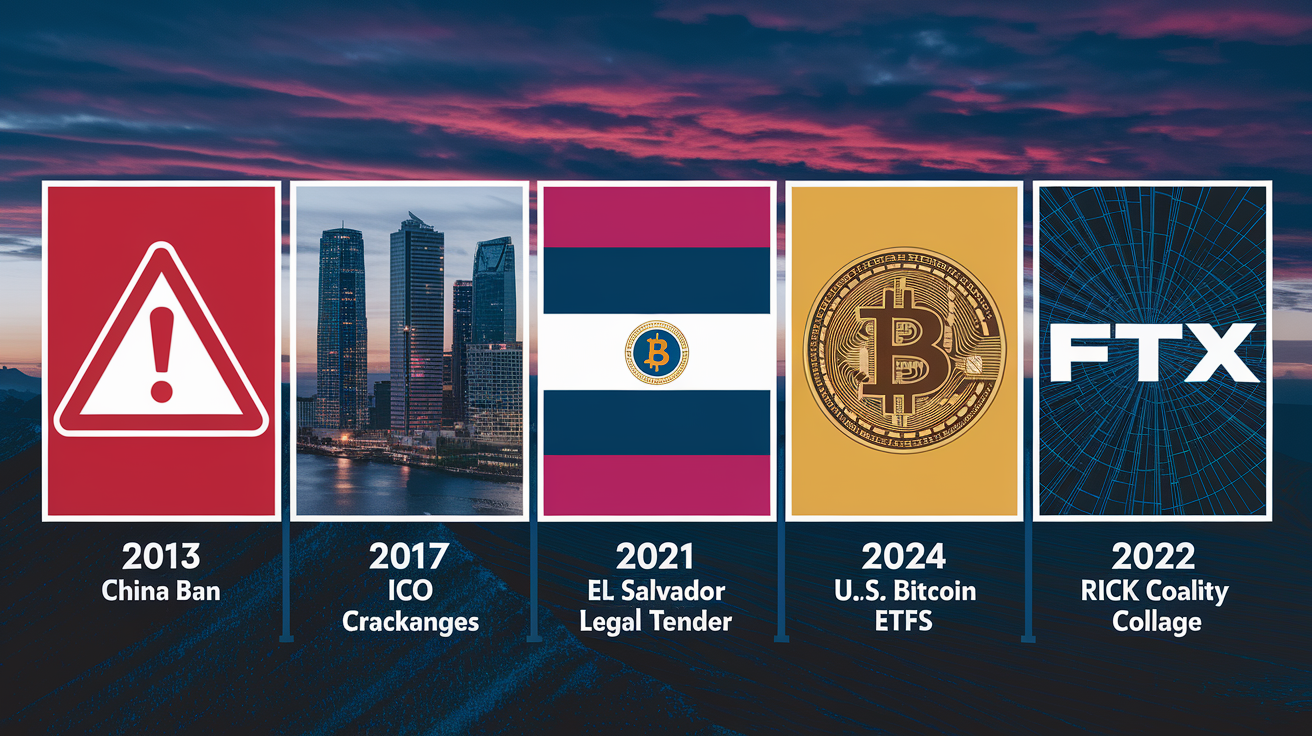
Regulatory events don’t just randomly move prices. They follow patterns tied to how severe the action is, how much weight that jurisdiction carries, and how clear the signal is. Looking at specific episodes shows how markets interpret and reprice Bitcoin in real time.
China’s Multi-Year Crypto Crackdowns
China’s regulatory approach has been the most disruptive globally, stripping out huge amounts of liquidity from Bitcoin markets in three major waves. On December 5, 2013, the People’s Bank of China banned financial institutions from handling Bitcoin transactions. The announcement triggered immediate selling. Bitcoin fell roughly 30% in the week after as Chinese exchanges saw withdrawals and traders repriced the risk of more restrictions coming. The move didn’t ban individual ownership, but it severed formal banking channels and signaled the state’s disapproval.
September 4, 2017 brought a broader crackdown. Chinese authorities banned ICOs and pressured domestic crypto exchanges to shut down. Bitcoin dropped about 15% in the days right after, then fell another 25% over the next two weeks as major platforms like BTCC, Huobi, and OKCoin stopped yuan trading. Mining stayed legal, but the trading infrastructure effectively disappeared from mainland China.
The final escalation came in September 2021 when authorities issued a sweeping ban on all crypto transactions, calling them illegal. Bitcoin fell around 10% right away, then stayed under pressure for weeks as miners fled the country and institutional players repositioned. Long term, it meant a geographic shift of hash rate and liquidity to North America and Central Asia. Short term, it was brutal: liquidity dried up, volatility spiked, and confidence took months to rebuild.
U.S. Enforcement Actions and Market Volatility
U.S. regulatory moves tend to hit fast but recover quicker because the legal process is transparent and markets can assess the scope pretty fast. On December 22, 2020, the SEC sued Ripple Labs, saying XRP was an unregistered security. Within days, XRP lost over 40% as exchanges (Coinbase, Kraken, Binance.US) delisted it to avoid legal exposure. Bitcoin fell about 10% in sympathy as traders worried the SEC might try the same logic on other tokens or even Bitcoin.
June 5, 2023 saw coordinated SEC enforcement against major exchanges, including Coinbase and Binance, over alleged violations for listing unregistered tokens. Bitcoin dropped roughly 5 to 10% intraday when the news broke. Volume spiked, derivatives open interest shrank, and liquidity providers pulled back. The drop was less brutal than earlier enforcement events because the market had partially priced in regulatory scrutiny, but the headline shock still drove measurable volatility.
The pattern holds: U.S. enforcement creates immediate selling, but prices usually stabilize within days as the market digests the specific charges and figures out whether Bitcoin itself is actually in the crosshairs. What lingers is higher volatility and reduced institutional appetite until clarity comes from court rulings or regulatory guidance.
ETF Approvals and Institutional Catalysts
Positive regulatory news does the opposite. Sustained inflows and price appreciation. On January 10, 2024, the SEC approved the first U.S. spot Bitcoin ETFs, ending years of delays and rejections. Bitcoin’s price jumped roughly 10% in the days right after approval, then went up another 30 to 40% over the next two months as billions flowed into the new products. The approval was a structural turning point: it gave retail and institutional investors a regulated, liquid vehicle without the custody and compliance headaches of holding Bitcoin directly.
Institutional inflows were real and measurable. ETFs from BlackRock, Fidelity, and others accumulated tens of billions in assets within weeks. Those inflows translated directly into spot buying, tightening supply and pushing price up. Volatility dropped as market depth improved and liquidity providers got comfortable with stable regulatory treatment.
The ETF approval also validated Bitcoin as investable in the eyes of compliance teams and fiduciary managers. Allocations that had been blocked for years suddenly became allowed, creating a step-function jump in demand that markets had sort of anticipated but hadn’t fully priced in.
Global Regulatory Milestones: EU MiCA and El Salvador
The EU’s Markets in Crypto-Assets framework moved through final legislative stages in April to June 2023, giving the first comprehensive EU-wide regulatory regime for crypto. MiCA’s approach (licensing exchanges, requiring reserve disclosures for stablecoins, setting capital and conduct standards) created clarity that U.S. markets still didn’t have. Bitcoin’s price rose modestly during the MiCA rollout, backed by expectations that institutional European capital would enter through newly compliant platforms.
El Salvador adopting Bitcoin as legal tender on June 9, 2021, was more symbolic than material in terms of direct capital flow. The country’s economy is tiny relative to global Bitcoin markets, but the announcement carried psychological weight: a sovereign state formally embracing Bitcoin validated its use case as currency and medium of exchange. Bitcoin rose about 10% in the week after the announcement, driven mostly by retail enthusiasm. Longer-term price impact was limited, but the event marked a shift in how governments publicly engaged with Bitcoin.
Taxation and Industry Failures: India’s Tax Regime and FTX 2022
India’s 2022 budget introduced a 30% tax on crypto gains and a 1% tax deducted at source on every transaction. The rules went live in the 2022 to 23 financial year. Retail trading volume in India collapsed. Some estimates put the drop at 90% in local exchange activity. Bitcoin’s global price saw limited immediate impact because India’s volume share was modest, but the episode showed how punitive tax setups can functionally ban participation without an explicit prohibition. The TDS mechanism made frequent trading uneconomical, and holders either moved offshore or stopped transacting.
FTX’s bankruptcy filing on November 11, 2022, was the biggest single industry shock of that year. Bitcoin fell roughly 20 to 30% in the weeks after as confidence evaporated and liquidity tightened. The collapse came after revelations that FTX had misused customer deposits and lacked basic financial controls. The court-secured default order required payment of $12.7 billion, a figure that represented locked capital unable to flow back into markets. The event showed how enforcement failures and systemic fraud can produce price shocks comparable to direct regulatory bans.
| Regulatory Event | Date | Typical BTC Price Change |
|---|---|---|
| China PBOC restrictions | Dec 5, 2013 | −30% within one week |
| SEC lawsuit vs Ripple | Dec 22, 2020 | −10% sympathy decline |
| China nationwide transaction ban | Sept 2021 | −10% immediate, sustained pressure |
| U.S. spot Bitcoin ETF approval | Jan 10, 2024 | +10% days, +30–40% two months |
| FTX bankruptcy filing | Nov 11, 2022 | −20–30% within weeks |
Quantitative Patterns of Bitcoin Price Movement After Regulations

Bitcoin’s volatility spikes predictably around regulatory announcements. Normal market conditions might show 24-hour volatility around 2 to 4%. When a major regulatory event hits (enforcement action, exchange ban, ETF approval), that can jump to 8 to 12% or higher as traders reprice risk and algos react to headlines. How big the spike is depends on whether the event was expected: leaked drafts or anticipated decisions produce smaller moves. Surprise announcements generate bigger swings.
Trading volume surges right after regulatory news breaks, often doubling or tripling average daily levels. That volume shows both real position adjustments and algo activity front-running expected flows. Liquidity depth (measured by order book size near current price) tends to thin as market makers widen spreads to manage inventory risk. High volume combined with reduced depth amplifies intraday swings and raises the chance of cascading liquidations in derivatives.
Common patterns you’ll see:
- Regulatory bans or enforcement actions typically produce declines of 10 to 60%, with the lower end for Bitcoin and the higher end for directly targeted altcoins.
- ETF approvals or major custody rule clarity can generate multi-week rallies of 20 to 50%, driven by sustained institutional inflows.
- Volatility stays elevated for 5 to 10 days after the initial event, then gradually returns to baseline as the market absorbs the news and positions stabilize.
- Exchange inflows spike during negative regulatory news as holders move coins to sell. Outflows increase after positive news as buyers move coins to self-custody.
- Derivatives open interest often contracts sharply during high-uncertainty periods as leveraged traders close positions or get liquidated.
- Institutional product flows (ETF net inflows, CME futures open interest) respond slower but more persistently to regulatory clarity, providing sustained demand over weeks and months.
How Investors Interpret Crypto Regulations as Price Signals

Delistings, bans, and enforcement actions are immediate red flags. When an exchange pulls a token or a regulator issues a cease-and-desist, it tells investors legal risk just went up, access just narrowed, or the asset’s use case is under threat. The market’s response is to sell first and ask questions later. Liquidity evaporates, prices drop, volatility spikes. Even if Bitcoin itself isn’t directly in the crosshairs, contagion spreads as traders assume broader scrutiny is coming. The December 2020 Ripple lawsuit triggered sympathy selling across crypto because it raised the possibility that the SEC might classify other tokens as securities, limiting where and how they could trade.
Positive signals (ETF pathways, custody rule approvals, legal classification clarity) reduce the risk premium investors demand to hold Bitcoin. When the SEC approved spot Bitcoin ETFs in January 2024, it signaled that Bitcoin was investable within the existing regulatory framework and that institutional products could operate without constant legal threat. That clarity unlocked capital from investors who’d been sitting on the sidelines. The result was sustained inflows, tighter spreads, and price appreciation that lasted for months. Positive regulatory developments don’t just remove downside risk. They expand the addressable market by making Bitcoin accessible to participants who need legal certainty.
Investors watch a consistent set of tools to read regulatory sentiment in real time. Exchange inflows and outflows show whether holders are moving coins to sell or to self-custody. ETF flows track institutional demand directly. On-chain metrics (exchange reserves, stablecoin supply changes) reveal shifts in liquidity and trading capacity. Volatility measures and bid-ask spreads capture market makers’ confidence in price stability. When regulatory headlines break, all these metrics move in predictable directions, giving investors a framework to assess whether the news is likely to produce a short-term shock or a sustained trend change.
Future Regulatory Trends Expected to Move Bitcoin’s Price

Stablecoin regulation is the most immediate catalyst coming. The GENIUS Act, enacted in July 2025, established the first federal U.S. framework for payment stablecoins, requiring reserve backing, monthly audits, strict AML compliance, and consumer priority in bankruptcy. Stablecoins meeting the Act’s standards aren’t treated as securities just for complying with the law. This clarity stabilizes the on-ramp and off-ramp infrastructure that underpins Bitcoin trading. When stablecoins are transparent and reliable, traders face lower counterparty risk, liquidity deepens, and short-term volatility declines. If stablecoin issuers fail audits or face enforcement, liquidity can freeze, spreads widen, and Bitcoin’s price takes a hit.
Cross-border coordination is picking up speed. The Financial Action Task Force sets global AML and counter-terrorist financing standards, and its guidance on crypto travel rules (requiring exchanges to share sender and recipient info for large transfers) forces platforms to upgrade compliance infrastructure or exit certain markets. When major jurisdictions adopt FATF standards together, liquidity gets more concentrated in compliant venues. That concentration can reduce volatility over time by professionalizing the market, but it also creates transition risk: exchanges that can’t meet standards shut down, removing regional liquidity and temporarily increasing price fragmentation.
Stablecoin Reserve Rules and Bitcoin Liquidity
Stablecoin transparency directly affects Bitcoin’s trading environment. Most Bitcoin trading pairs on exchanges use stablecoins (USDT, USDC, others) as the quote currency. When reserve rules require monthly audits and full backing, traders trust that a stablecoin won’t break peg during volatility. That trust keeps liquidity flowing even during market stress. If a major stablecoin were to depeg or collapse (like TerraUSD did in May 2022), Bitcoin’s price would likely fall sharply as traders rush to exit and liquidity providers pull back.
The GENIUS Act’s bankruptcy priority provision (giving stablecoin holders senior claim on reserves) reduces tail risk for institutional users. That protection makes stablecoins more attractive as a settlement layer for large trades, which increases the capital available to trade Bitcoin. Institutional flows depend on reliable infrastructure, and stablecoin regulation is a key piece.
Cross-Border Coordination and AML/KYC Harmonization
Fragmented national rules create compliance headaches and cut market efficiency. When one jurisdiction requires travel rules and another doesn’t, exchanges face a patchwork of obligations that raise costs and limit interoperability. The Bank for International Settlements, Basel Committee on Banking Supervision, and Financial Stability Board are working toward harmonized standards for stablecoins, bank crypto exposure, and central bank digital currencies. As these standards converge, institutions gain clarity on global capital requirements and risk weightings, which can unlock cross-border institutional flows into Bitcoin.
Harmonization also reduces regulatory arbitrage. When rules are similar across major markets, capital is less likely to flee to offshore or low-compliance venues. That concentration of activity in regulated markets improves price discovery, tightens spreads, and reduces the risk of exchange failures that produce systemic shocks.
CBDC Rollouts and Shifts in Digital Money Demand
Central bank digital currencies represent a potential substitute for some of Bitcoin’s use cases, particularly in payments and remittances. If CBDCs offer instant settlement, low fees, and government backing, retail users in some regions may prefer them over Bitcoin for transactional purposes. That shift could reduce Bitcoin’s velocity and limit price appreciation driven by payment adoption. Bitcoin’s store-of-value and censorship-resistance properties remain distinct from CBDCs though, which are centrally controlled and lack supply caps.
CBDC pilots are underway in China, the EU, and other jurisdictions. If a major economy successfully launches a retail CBDC, the initial market reaction will likely be negative for Bitcoin as traders price in reduced use-case overlap. Longer term, the impact depends on how CBDCs are designed. If they preserve privacy and limit state surveillance, they may coexist peacefully with Bitcoin. If they impose capital controls or restrict cross-border flows, Bitcoin’s demand as a neutral, permissionless alternative could increase, supporting price over time.
Final Words
Regulatory headlines still spark fast, sharp moves, triggering sentiment shocks, liquidity squeezes, and sudden repricing.
We walked through immediate reactions and the deeper mechanics: market access limits, ETF and custody shifts, tax rules, and enforcement-driven contagion.
Bottom line: this piece explains how crypto regulations affect bitcoin price by changing liquidity, flows, and risk premiums. More predictable rules usually cut volatility and attract institutional demand — a cleaner path for bitcoin over time.
FAQ
Q: What affects Bitcoin prices the most?
A: The factors that affect Bitcoin prices the most are regulatory announcements, macro policy and real yields, liquidity and exchange flows (including ETFs), large firm or exchange failures, and shifts in demand or adoption.
Q: Is regulation good or bad for crypto, and do regulatory changes affect crypto?
A: Regulation affects crypto by providing clarity that can boost institutional inflows and lower risk premiums, while punitive bans or unclear rules often trigger volatility, reduced liquidity, and selling pressure.